Guide
Learning languages with podcasts
Podcasts deliver what textbooks lack: real speech at real speed, with filler words, accents and topics you actually care about. Without a method, though, very little sticks. This guide closes that gap.
Why podcasts work as learning material
Textbook audio is optimised for comprehensibility: clearly articulated, moderately paced, free of background noise. That's precisely why it prepares you poorly for real conversation. Podcasts bring unfiltered speech, with elisions, interruptions and regional colour, along with context that makes retention easier. If the topic interests you, you keep listening voluntarily, and repetition is the actual active ingredient in language acquisition.
The two most common mistakes: material that's too hard, and purely passive listening. Both are fixable.
Finding the right level
| Level | Suitable material | Approach |
|---|---|---|
| A1–A2 | Beginner learner podcasts, slow news | Short episodes, repeated listens, transcript from the start |
| B1–B2 | Interview and narrative formats on familiar topics | First without transcript, then with; reduce speed slightly |
| C1–C2 | Anything natives listen to: debate, comedy, specialist shows | Normal speed, transcript only when needed |
Rule of thumb: if you roughly understand 70 to 80 percent on first listen, the material is well chosen. Much below that is frustrating; much above it isn't demanding enough.
The method in five steps
- Listen straight through once, with no transcript and no pausing. The goal is only the overall thread. Don't stop at every unknown word.
- Second pass with the transcript. Read along and mark the places where listening and reading diverged. That's where your actual gap sits.
- Slow down the hard parts. 0.8x makes elisions audible without destroying the melody of the language. Repeat the passage two or three times.
- Take away five to ten expressions. Not isolated words but whole phrases in sentence context, which is what makes them retrievable later.
- Come back a few days later. Same episode, normal speed. Progress is most noticeable here, and that carries you through the plateaus.
Speed as a learning tool
Podknow offers 0.5x to 3.0x in fine steps and can remember the setting per podcast. Your learner show can sit permanently at 0.9x while familiar content stays at 1.5x, without readjusting every time.
What a podcast player needs for learning
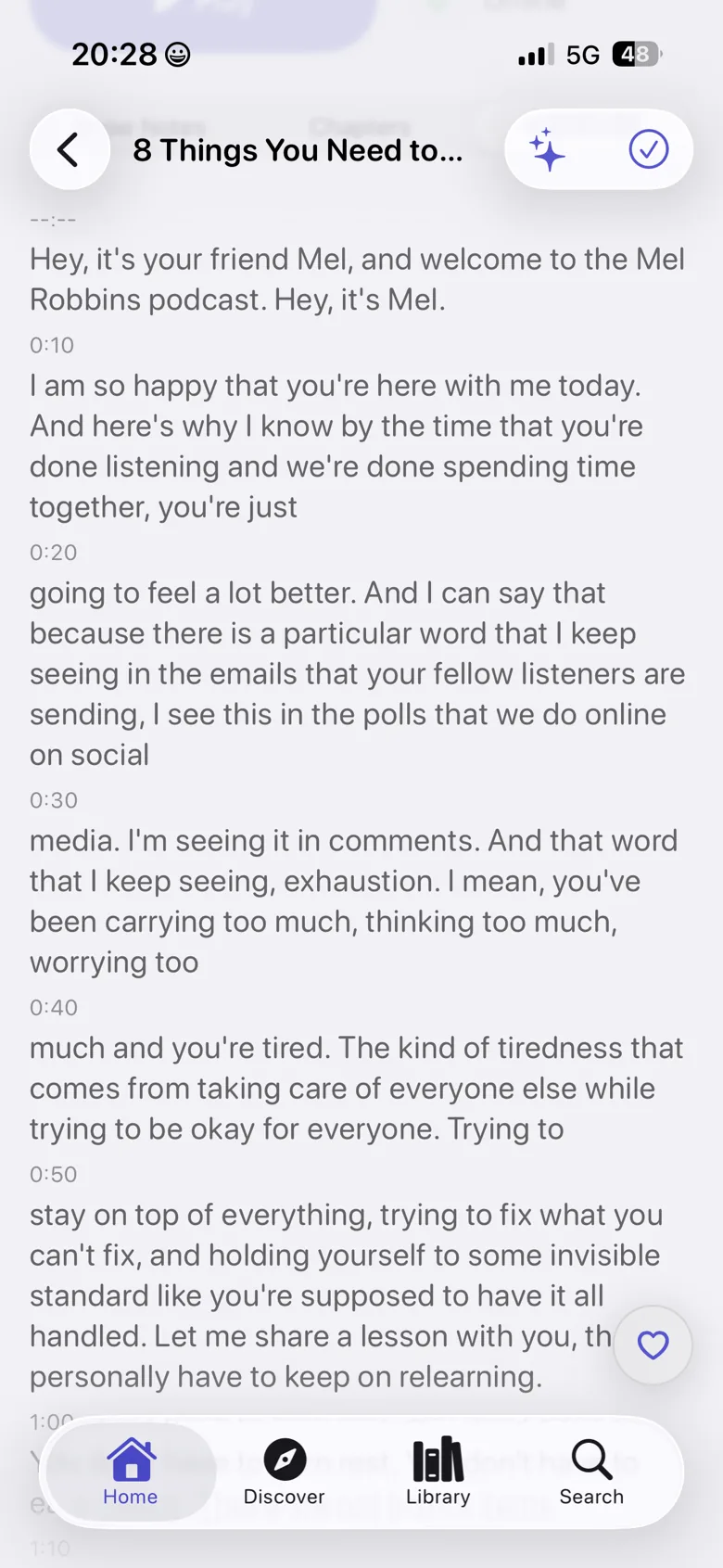
Transcript with jump marks
Tapping a sentence moves playback there. That's what makes targeted repetition of single passages practical at all.
Fine-grained speed per podcast
0.5x to 3.0x in small increments, saved per show rather than globally.
Short, custom skip intervals
A 10-second jump back instead of 30 lands on exactly the sentence you need again.
Full-text search
“Which episode had that expression again?” Search across all transcripts answers it.
Asking about the episode
The knowledge assistant explains a passage on the device, without leaving the app or uploading anything.
Offline
Commute time is study time. Downloaded episodes and their transcripts work with no connection.
Staying realistic
Podcasts train listening comprehension and vocabulary very effectively. They don't cover speaking or writing. As the sole route to fluency they aren't enough; as a daily dose of authentic language alongside lessons or a conversation partner they're hard to beat. Twenty minutes a day beats three hours on a Sunday.
Frequently asked
Learning languages with podcasts
At what level do podcasts start making sense?
With dedicated learner podcasts and a transcript it works well from A2. For podcasts made for native speakers you want at least B1, otherwise frustration dominates.
Does slower playback actually help?
Yes, in moderation. Around 0.8x elisions become audible without the melody sounding unnatural. Below 0.7x speech is distorted enough that the benefit drops again.
Do I need a transcript for every episode?
It's very valuable for the second pass and rather counterproductive for the first listen. Podknow shows publisher transcripts for free and can generate one on-device for episodes without.
Can I save vocabulary in Podknow?
Podknow is not a vocabulary app. Instead of flashcards you can find episodes and passages again at any time via full-text search. Pair it with a dedicated study app for spaced repetition.
Does this work offline on a train?
Yes. Downloaded episodes including transcripts and the local AI features work without an internet connection.
Listen to podcasts. Keep the knowledge.
Podknow is free on the App Store. Add Premium whenever you like.
Free for iPhone & iPad · AI features as a Premium upgrade, subscription optional (lifetime)
Keep reading
Podcast transcripts on iPhone
How to get a transcript for any podcast episode, including shows that don't ship one. Three approaches compared, and why on-device transcription is the private option.
PricingA podcast app without a subscription
Why nearly every AI podcast app demands a subscription, when a one-time purchase is possible, and what stays free in Podknow versus what Premium unlocks.
ComparisonA Spotify alternative for podcasts
Why a dedicated podcast player beats a music app with a podcast tab: open RSS feeds, no exclusives, no listening profile. Comparison and migration guide.