Privacy
A podcast app without tracking
What you listen to reveals more about you than almost any other digital trace: politics, health, finances, relationship status, working hours. That's exactly why it's worth asking who is reading along inside your podcast app.
What podcast apps typically collect
Not every app does all of this, but each item is common practice in the industry:
- Analytics SDKs log which screens you open, how long you stay and where you drop off.
- Advertising SDKs tie your device to an ad identifier and sort you into audiences.
- Mandatory accounts bind your entire listening history permanently to an email address.
- Server-side playback state sends every position change to a service. Needed for cross-device sync, but also a complete log.
- Recommendation engines require a profile of your interests in order to work at all.
Individually this looks harmless. Combined it produces a remarkably precise picture, one that can be sold, analysed or handed over.
What “no tracking” means in Podknow
No analytics or advertising SDKs
The app embeds no tracking framework. There is no usage telemetry being reported anywhere and no ad identifier being read.
No account, no sign-up
Without an account there is no identifier a history could be permanently attached to.
AI on the device, not in the cloud
Transcripts, summaries and the questions you ask about an episode are processed locally. No Podknow server exists that could see them.
Statistics stay local
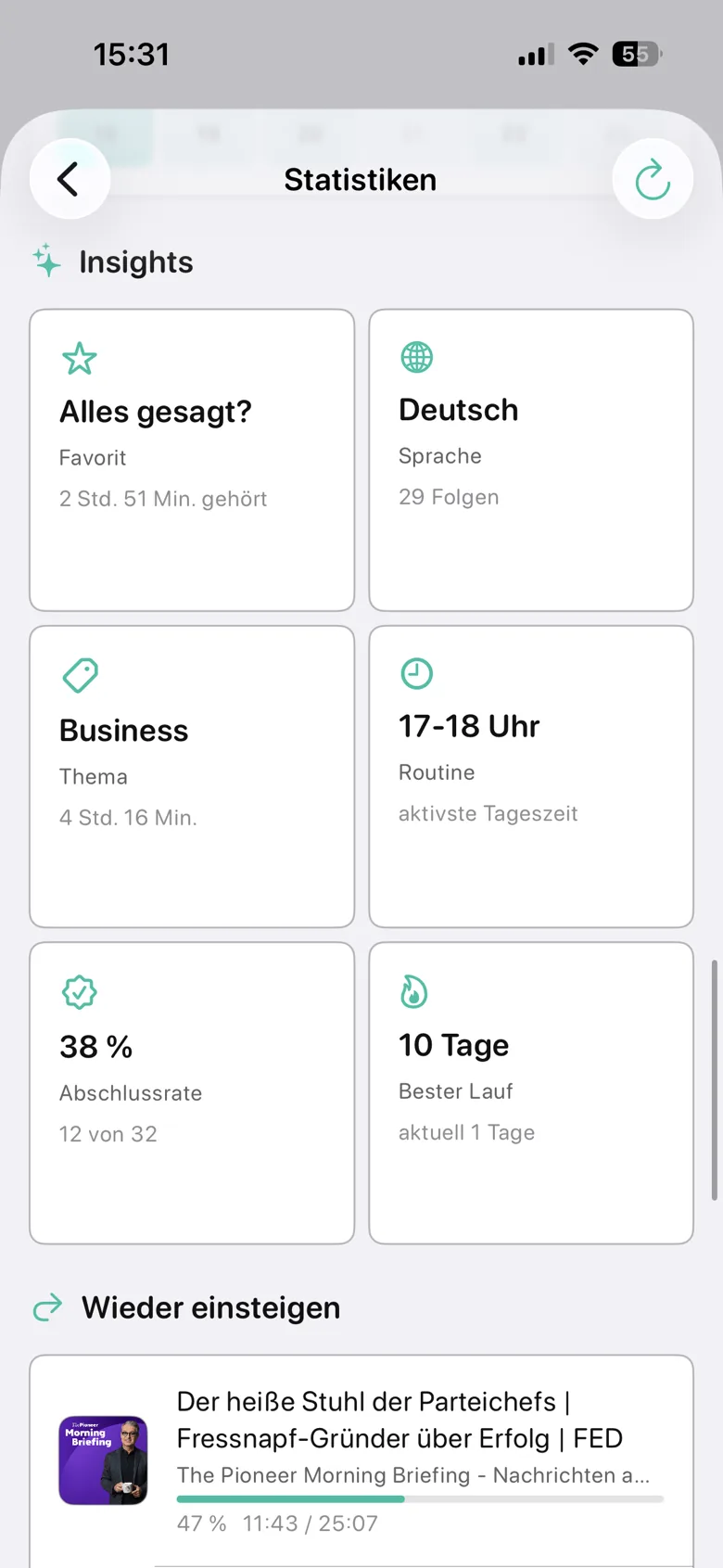
Listening time, streaks, heatmaps and the year in review are computed and stored on the device. A feature for you, not a dataset for us.
Sync through your Apple ID
If you want sync, it runs over iCloud, on Apple's infrastructure under your own account rather than ours.
Export at any time
OPML export and full backups. Data you can take with you is data that doesn't hold you.
What stays visible anyway, and why
This is where a lot of marketing copy gets dishonest, so plainly: podcast hosts can see your episode requests. When your iPhone downloads an episode, the show's server records an access log entry with IP address and user agent, exactly as when you visit any website. That's how RSS and HTTP work, and it applies to every podcast app, Podknow included.
The difference lies in what happens on top. A platform links that request to your account, your history and the rest of your activity to form a profile. With a local player it stays a single request that can't be attributed to anyone. The app itself records nothing about it.
Checklist: spotting an app that takes privacy seriously
- The App Store privacy label is short. “Data Not Collected” is a meaningful statement, since Apple requires the developer to declare it.
- The app works without an account. Anything that forces registration inevitably builds a profile.
- There is an export. Offering OPML export is a deliberate rejection of lock-in.
- The privacy policy is specific. Named processors and retention periods instead of generic boilerplate.
- AI features are explained. Where exactly does processing happen? “Secure” and “encrypted” don't answer that question.
Why the European frame is more than a label
The GDPR demands data minimisation and purpose limitation. Those principles are most reliably met by not collecting data in the first place. Podknow is developed in Germany and built along that logic: privacy here is an architectural decision, not a switch in a settings menu. Details are in the privacy policy.
Frequently asked
A podcast app without tracking
Does Podknow really collect no usage data?
The app embeds no analytics or advertising SDKs and reports no usage telemetry to any server. Listening statistics are computed locally and stay on the device.
Can the podcast publisher see that I'm listening?
The host sees the download request including your IP address, just like any website visit. That's technically true for every podcast app. Podknow adds nothing to it and links it to nothing.
What happens when iCloud sync is enabled?
Your data then sits in your own iCloud account at Apple, not with us. We have no access to it.
Where are my questions to the knowledge assistant processed?
On the iPhone, via Apple Intelligence. Neither the question nor the answer nor the episode content is sent to any service.
Are there ads in the app?
No. Podknow is funded by the Premium upgrade, not advertising. Ads inside individual podcast episodes belong to that podcast and remain.
Listen to podcasts. Keep the knowledge.
Podknow is free on the App Store. Add Premium whenever you like.
Free for iPhone & iPad · AI features as a Premium upgrade, subscription optional (lifetime)
Keep reading
A Spotify alternative for podcasts
Why a dedicated podcast player beats a music app with a podcast tab: open RSS feeds, no exclusives, no listening profile. Comparison and migration guide.
PricingA podcast app without a subscription
Why nearly every AI podcast app demands a subscription, when a one-time purchase is possible, and what stays free in Podknow versus what Premium unlocks.
GuidePodcast transcripts on iPhone
How to get a transcript for any podcast episode, including shows that don't ship one. Three approaches compared, and why on-device transcription is the private option.